Updated August 23, 2016
By Rafik Beekun at the Islamic Workplace weblog
A step-by-step description of how to pray Salat-ul-Istikhara and, Insha Allah, how to interpret it.
- Click here to download the English only step by step description of how to pray Salat Istikhara in a one-page 12 size font handout.
- Click here to download the English only step by step description of how to pray Salat Istikhara in a two-page 18- size font handout.
- Please click here to download “How to pray Salat-ul-Istikhara” in pdf format (Arabic, English, French, German and Spanish).
BEFORE downloading any of the above documents, please view the videoclips included on this web page. They are meant to help you recite the Istikhara dua correctly, and to understand the significance of the Istikharaprayer, Insha Allah. The step-by-step process is listed in the blue box below, and the du’a you need to recite is highlighted in yellow. You can also download an English only version step-by-step description of how to pray Salat Istikhara by clicking here.
What is Salat ul Istikhara?
Source: Fiqh-us-Sunnah, volume 2, number 32 and volume 4, number 141.
Often, we have to make major life-changing decisions: whether to undertake a major project or not, whether to apply for a promotion or not, whether to change career or not, whether to invest in a certain company or not, whether to get married or not, whom to get married to, etc.
Istikhara (Arabic) means to ask Allah to guide one to the right thing concerning any affair in one’s life, especially when one has to choose between two permissible alternatives, e.g. a career choice, getting married, etc. Similarly, a traveller should consult good righteous persons before setting out on a journey, because Allah says, “And consult them (O Prophet) in affairs (of moment),” (Qur’an, 3: 159) and one of the characteristics of the believers is that “they (conduct) their affairs by mutual consultation” (Qur’an, 42: 38). Qatadah said, “Every people who seek the pleasure of Allah and consult with one another are guided to the best course in their affairs.” The traveller should also make istikharah and seek guidance from Allah.
Sa’ d ibn Waqas reported that the Prophet, peace be upon him, said, “Istikharah (seeking guidance from Allah) is one of the distinct favors (of Allah) upon man, and a good fortune for the son of Adam is to be pleased with the judgment of Allah. And a misfortune of the son of Adam is his failure to make istikharah (seeking Allah’s guidance), and a misfortune for the son of Adam is his displeasure with the judgment of Allah.” Ibn Taimiyyah said, “He who seeks guidance from the Creator and consults the creatures will never regret it.”
How does one pray Salat ul Istikhara?
Salatul Istikharah is a sunnah of the Prophet (s). It is a prayer that one may pray if one must choose between permissible alternatives: it is two non-obligatory rak’at (that can be recited separately or in combination with the regular sunnah prayers or the prayer for entering the mosque […] during any time of the day or night, and to recite therein whatever one wishes of the Qur’an after reciting al-Fatihah. After the two-rak’ats, one praises Allah and sends salutations to the Prophet sallallahu alehi wasallam and recites the following supplication which has been recorded by al-Bukhari in Jabir’s hadith (see full text below): “The Prophet sallallahu alehi wasallam would teach us al-istikhara for all of our affairs as he would teach us a surah from the Qur’an. He said: ‘If one of you is deliberating over an act, he should pray two non-obligatory rak’at and say:“O Allah, I consult You as You are All-Knowing and I appeal to You to give me power as You are Omnipotent, I ask You for Your great favor, for You have power and I do not, and You know all of the hidden matters . O Allah ! If you know that this matter (then the person reciting the du’a should mention the matter for which he is seeking Allah’s Guidance) is good for me in my religion, my livelihood, and for my life in the Hereafter, (or he said: ‘for my present and future life,’) then make it (easy) for me. And if you know that this matter is not good for me in my religion, my livelihood and my life in the Hereafter, (or he said: ‘for my present and future life,’) then keep it away from me and take me away from it and choose what is good for me wherever it is and please me with it.”
The following hadith (referred above in Fiqh-us-Sunnah) is narrated by Jabir bin Abdullah about Salat-ul-Istikhara in Sahih Bukhari (volume 2, hadith number 263 and again volume 9, hadith 487):
The Prophet (peace be upon him) used to teach us the way of doing Istikhara (Istikhara means to ask Allah to guide one to the right sort of action concerning any job or a deed), in all matters as he taught us the Suras of the Quran. He said, “If anyone of you thinks of doing any job he should offer a two Rakat prayer other than the compulsory ones and say (after the prayer): ‘Allahumma inni astakhiruka bi’ilmika, Wa astaqdiruka bi-qudratika, Wa asaluka min fadlika al-‘azim Fa-innaka taqdiru Wala aqdiru, Wa ta’lamu Wala a’lamu, Wa anta ‘allamu l-ghuyub. Allahumma, in kunta ta’lam anna hadha-l-amra (then the person reciting the du’a should mention the matter for which he is seeking Allah’s Guidance) Khairun li fi dini wa ma’ashi wa’aqibati amri (or ‘ajili amri wa’ajilihi) Faqdirhu li wa yas-sirhu li thumma barik li Fihi, Wa in kunta ta’lamu anna hadha-lamra shar-run li fi dini wa ma’ashi wa’aqibati amri (or fi’ajili amri wa ajilihi) Fasrifhu anni was-rifni anhu. Waqdir li al-khaira haithu kana Thumma ardini bihi.‘
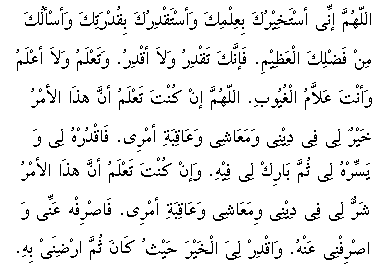
Note from Rafik Beekun: I have included the french, german and spanish translations of the above dua at the end of this post.
Similar hadiths were reported by Jabir (r) in Sahih Bukhari (volume 8, hadith number 391).
Note from Rafik Beekun: If you have trouble with the arabic version of the dua for Istikhara, here is a dua video where the dua is being recited in arabic. Both the arabic version of the du’a, its english transliteration, and translation are included. Please use it to practice reciting the dua correctly before praying Salat Istihara:
Salat ul Istikhara: Prayer for consultation
Memorizer for the du’a for Salat ul Istikhara
If you cannot view the above video clip, please click here to hear the MP3 version of it.
To summarize, here is how you pray Salat-ul-Istikhara step-by step:
|
What happens after one prays Salat ul Istikhara?
An-Nawawi holds that “after performing the istikharah, a person must do what he is wholeheartedly inclined to do and feels good about doing and should not insist on doing what he had desired to do before making the istikharah. And if his feelings change, he should leave what he had intended to do, otherwise he is not completely leaving the choice to Allah, and would not be honest in seeking aid from Allah’s power and knowledge. Sincerity in seeking Allah’s choice, means that one should completely leave what he himself had desired or determined.” [Note from Br. Rafik Beekun: Please view the video on “Istikhara and Marriage” at the bottom of this web page where the Sheikh elaborates on the different ways in which your prayer will be answered, Insha Allah}
It is not necessary that you get a dream or even a “feeling.” Rather, the istikhara is a prayer that Allah guide you towards that which is best (khayr) for you. If you do the prayer of guidance (istikhara) with the proper manners, the most important of which is to truly consign the matter to Allah and suspend your own inclinations, then Allah will make events unfold in the direction that is the best for your worldly and next-worldly affairs.
Please remember that the core of being a Muslim is to put your absolute trust in Allah. Accordingly, once you perform the prayer of Istikharak, you need to follow the guidance of Allah whether it means pursuing or abandoning the intended undertaking. Allah also says:

“And He provides for him from (sources) he never could imagine. And if any one puts his trust in Allah, sufficient is ((Allah)) for him. For Allah will surely accomplish his purpose: verily, for all things has Allah appointed a due proportion.” (Qur’an 65:3)
How many times can one pray Salat ul Istikhara?
As stated above, there is no limit on the number of times you can pray Salat ul Istikhara . though the fuqaha mention that it is recommend to repeat it, up to 7 times if necessary (usually done on separate occasions). [cf: Radd al-Muhtar]
Salat Istikhara and Marriage
Sunni Path Academy
Clip from SunniPath Answers Live event. This answer addresses the issue of how to pray Salat al-Istikhara, particularly in relation to marriage. Answered by Shaykh Hamza Karamali
Divine GPS: The Inner Dimensions of Salat Istikhara
This 39 minute lecture is by Imam AbdulBary Yahya. He was born in Vietnam during the Vietnam War, and very soon thereafter immigrated to the U.S. with his family. He grew up in Seattle, WA and after completing his primary and secondary education there, began his studies at the Islamic University of Madinah. It was at the University that he befriended Muhammad Alshareef, as they sat next to each other in the first year of their studies.
Upon graduation from the Islamic University of Madinah’s College of Shariah, AbdulBary Yahya returned to Vietnam and Cambodia and became a teacher and director of the Revival of Islamic Heritage Society in Cambodia and the Umm al-Qura Charity Organization in Vietnam.
He presently resides in Seattle, WA with his family, and is an instructor with AlMaghrib Institute, an organization that provides trademark double-weekend seminars leading students towards a bachelor’s degree in Islamic Studies. He is currently the Imam (spiritual leader and adviser) of Masjid Jaamiul Muslimeen in Seattle, WA. He also holds the positions of President of the Cham Refugee Community and Vice-President of the Islamic Center of Washington State.
Common Questions and Answers about Istikhara
All answers are from the scholars at Islamonline.com
1. What matters can one seek guidance from Istikhara and what matters are best dealt with the use of the intellect and not Istikhara?
Praise be to Allaah.
It is not correct to divide matters, when deciding whether it is permissible to pray istikhaarah regarding them, into the two categories of matters which are subject to rational thinking, in which one should not pray istikhaarah, and matters that are not subject to rational thinking, concerning which one may pray istikhaarah.
Rather what is prescribed in all cases – both major and minor – is to use one’s intellect and wisdom, and to study the options and available means. If a person is hesitant about some matter or it is not clear which choice is the correct choice on the basis of shari evidence, if it is a shari matter, or the basis of rational proof or proof based on experience, and so on, according to the nature of the matter in question – if he is uncertain and it is not clear based on whatever evidence is appropriate in that case, then he should delegate his affairs to Allah, asking Him for guidance and declaring his helplessness before Him, and pray istikhaarah, which is a supplication to Allah, asking Him for guidance and success after examining the available options on a rational basis.
Istikhaarah does not cancel out rational thinking or examining one’s circumstances; rather it is complementary to that. [Please click here to read the remainder of the answer]
2. Can istikhaarah prayer be performed at the time when prayer is not allowed?
[Previously], we have stated the times at which the Prophet (peace and blessings of Allaah be upon him) forbade prayer. What is meant by this forbidding is general naafil prayers for which there is no reason. As for naafil prayers for which there is a reason, such as greeting the mosque, they may be offered at these times when prayer is not allowed.
The scholars differed concerning istikhaarah prayer and whether it is regarded as a prayer for which there is a reason, or not.
The correct view is that if istikhaarah is done for something that is immediate and cannot be delayed, then this prayer may be performed at a time when prayer is not allowed, such as if a person wants to travel after âAsr prayer. But if the matter is not immediate and the prayer can be delayed until after the time when prayer is not allowed is over, then it should not be performed at that time.
Please click here to read the remainder of this fatwa.
3. What are common misconceptions about Salat Istikhara?
Misconception #1:
Some people think that the istikhârah prayer is only prescribed when a person has to decide between two options. People arrive at this misunderstanding since the word “istikhârah” literally means “to seek (someone else’s) decision on a matter”. Some people jump to the conclusion that this means that they must be in a situation where they have to decide between two things.
However, the Prophet (peace be upon him) said we should offer the istikhârah prayer whenever we are thinking about embarking upon something. He said: “When one of you thinks to embark upon something, he should offer two units of prayer other the obligatory prayer” [Sahîh al-Bukhârî]
He did not say: “Whenever you are wavering between two options ”
Therefore, the istikhârah prayer is prescribed for us whenever we have a concern to embark upon a course of action but have not yet developed a firm and unwavering resolve to do so. Even if it is a single course of action with no alternative option open to us, we still have the choice between undertaking that course of action or not undertaking it. We should offer the istikhârah prayer.
On the other hand, if there are multiple options open to us, we should first consult with knowledgeable people we trust as to which course of action is best for us. Then we should pinpoint the course that appears to be the best to us and offer the istikhârah prayer about that choice, seeking Allah’s decision on the matter.
Misconception #2:
Some people think that the istikhârah prayer is prescribed only for a limit set of actions, like marriage and travel. Others feel that the prayer is only for actions of paramount importance, and not for everyday decisions. Both of these ideas are wrong. This misconception leads people to avoid praying the istikhârah prayer on many occasions where it would benefit them to do so. The prayer is prescribed for all of our decisions.
The narrator of the hadîth tells us: “He used to teach us the istikhârah prayer for all of our concerns ” This is general for all decisions, major and minor.
Misconception #3:
There is an idea that the istikhârah prayer requires the offering of two units of formal prayer exclusively with the intention istikhârah. This is really not a misconception, since there is legitimate scholarly disagreement on this issue. Nevertheless, I would still strongly argue that such a restriction is incorrect, because the Prophet (peace be upon him) said: “ offer two units of prayer other than the obligatory prayer.” This is general for all non-obligatory prayers, including the two-units we observe upon entering the mosque or after performing ablutions, and the two-unit Sunnah prayers we offer along with our obligatory prayers.
This means that we can beseech Allah with the istikhârah supplication after any two-unit voluntary prayer we make, whatever our initial intention was to offer that two-unit prayer. In this way, we can get the benefit of two acts of worship together, by intending a certain voluntary prayer and then offering the istikhârah supplication after it.
Misconception #4:
Some people assume that it is essential to experience some sort of resolve in the heart after performing the istikhârah prayer. There is no evidence to support this assumption. In fact, the istikhârah supplication belies this idea:
O Allah! I seek Your decision through Your knowledge and your facilitation through your power and I ask You of Your tremendous grace. For indeed, You are capable while I am not, and You know while I know not, and You are the Knower of the Unseen. O Allah! If you know this affair to be best for me in my religion, my livelihood, and in the final outcome (or: in my immediate life and my future one), then decree it for me and facilitate it for me and then bless me in it. And if You know this affair to be worse for me in my religion, my livelihood, and in the final outcome (or: in my immediate life and my future one), then turn it away from me and turn me away from it and decree for me what is good, wherever it may be, and then cause me to be contented with it.
If we consider what we are asking Allah in our istikhârah supplication, we are really leaving the decision in His hands. Whether or not we feel comfortable or happy with the course of action, we are asking Allah to bring it about for us if He knows it to be best for us and to keep it away from us if He knows it to be in our best interests not to be involved in it.
Allah says: “It is possible that you dislike a thing that is good for you, and that you love a thing that is bad for you. But Allah knows, and you know not. ” [Sûrah al-Baqarah: 216]
The assumption that some people have that the istikhârah prayer is supposed to manifest a sign or resolve in our hearts about the course of action has led to no end of confusion. They repeat their istikhârah prayers over and over again waiting to experience this resolve. When they do not experience it, their sense of confusion only increases. This is unfortunate, since the istikhârah prayer is supposed to help us shrug off our confusion by putting the matter in Allah’s hands.
To read about more misconceptions about Salat Istikhara, please click here.
Additional sources on Salat ul Istikhara:
1. Istikhara: The Guidance Prayer Q & A answered by Shaykh Faraz Rabbani
This article was researched very carefully, and all sources were checked. Please feel free to reproduce this article provided you do not make any changes to the article and provide a direct link to this article and webiste for the latest updated version, Insha Allah.
If you have questions about Salat Istikhara, its applicability in specific circumstances or its interpretation, here is a link that may help you Insha Allah: the Islamonline website. This website is excellent because you can ask some of the leading scholars in the Islamic world a specific question about your situation if you do not find an answer in their fatwa bank.
Another link that I have found useful in terms of interpretation and etiquette of Salat Istikhara is this one from Sunnah Path. Here is some additional information which I gleaned from the Sunnah Path website:
In general, when it is not possible to perform the istikhara prayer itself (such as when one is out on the road, or in one’s menstrual period), it is recommended to simply read the dua itself. [Radd al-Muhtar]
2. Excellent explanation in Urdu of Salat ul Istikhara by Dr. Israr Ahmed.
Leading and renowned scholar Dr. Israr Ahmed gives a talk about Salat ul Istikhara in Urdu (with English subtitles) on the importance of this prayer.
Dua e Istikahra in several languages
Traduction francaise du Dua pour la Salate ul Istikahara ou La Priere de Consultation
Traduction francaise de la priere istikara (la priere de la consultation ou demande du meilleur parti à prendre). D’abord, voici le Hadith Sahih rapporté par l’Imam Bokhari:
Selon Jaber Ben Abdallah (raa):
Le Prophète (saw) nous enseignait à demander l’inspiration à Dieu comme il nous enseignait les sourates du Coran. Il nous disait : Lorsque l’un de vous veut décider d’une chose qu’il fasse deux rakaates en dehors de la prière canonique puis qu’il dise
“O Seigneur je te demande en vertu de Ta Science de choisir pour moi la meilleure solution. je te demande de me l’accorder en vertu de Ta Prédestination, et je te demande de me faire bénéficier de Tes faveurs immenses, car Tu as la Puissance et j’en suis dépourvu, Tu es Celui qui Sait et je suis ignorant(e), et Toi seul connais le non-manifesté. O Seigneur si Tu sais que cette affaire m’est profitable pour ma vie en ce monde, pour ma religion ainsi que pour mes fins dernières (ou encor pour mon avenir immédiat ou lointain), destine la moi, rend la moi accessible et bénis la moi, mais si Tu sais que cette affaire m’est néfaste, tant pour ma religion que pour ma vie en ce monde et pour mes fins dernières, éloigne la de moi et éloigne moi d’elle, puis destine moi le bien où qu’il se trouve et rend moi satisfait(e) d’en avoir bénéficié”
Ensuite, qu’il indique son affaire.
[ Rapporté par Boukhari 6841. D’autre versions sont citées par at-Tarmidhi, an-Nassaï, Abou Dawoud, Ibn Madja et Ahmad]
Source of french translation: Forum de la grand mosquee de Lyon.
Salat-Al-Istikhara: Priere de la Consultation
Salate Istikhara (la prière de la consultation) est constituée de 2 raq’at, c’est à dire deux unités de prières, c’est la même que Salate el Fajar, la prière de l’aube.
Beaucoup ne la font que pour les grandes decisions, avant de prendre la decision de se marier par exemple, mais c’est une prière que tu peux faire pour n’importe quelle decision, que ce soit pour un voyage, un investissement, un travail… pour tout…
Il ne semble pas qu’il y ait un moment precis dans la journée pour la faire; le meilleur moment pour faire des prières surérogatoires, pour faire des Doh’as c’est la nuit, plus précisément le dernier tièrs de la nuit.
Muhammad Al-Arifi : La Prière de Consultation / Salat Al-Istikhara
Istikhara Gebet:
Recite dieses DUA nach Istikahra Gebetaus”Riyad-us-Salihin”Kapitel 14Gebet um Gottes Führung (Istikhara) und Beratung untereinanderQur”an: Allah, der Erhabene, spricht:
“… und ziehe sie in (allen weltlichen) Angelegenheiten zu Rate.” [3:159]”… und ihre Angelegenheiten in gegenseitiger Beratung regeln…” [42:38]Dschabir (r) berichtet: Der Gesandte Allahs (s) lehrte uns immer wieder, in jeder Angelegenheit, Gottes Führung {Istikhara) zu erbitten, wie er uns immer wieder eine Sure aus dem Qur’an lehrte.
Er sagte:”Wenn jemand von euch beabsichtigt, etwas zu tun, so soll er zusätzlich zwei Rak’a verrichten und dann sprechen: ‘Oh Allah! Ich bitte Dich um Deinen Rat aufgrund Deines Wissens; ich bitte Dich um Kraft aufgrund Deiner Kraft, und ich bitte Dich, mir von Deiner unermesslichen Güte (zu geben); denn Du allein hast die Macht und ich nicht. Du weißt alles und ich weiß nichts. Du allein weißt das Verborgene. Oh Allah! Wenn Du weißt, dass diese Sache gut für mich ist, für meine Religion, mein Leben auf Erden und für mein Leben im Jenseits, so bestimme sie mir, und erleichtere mir, sie zu erreichen! Dann segne dies (was Du mir gewährt hast). Weißt Du jedoch, dass diese Sache schlecht ist für mich, für meine Religion, für mein Leben auf Erden und für mein Leben im Jenseits, so wende sie von mir ab, und halte mich von ihr fern! Bestimme mir Gutes, wo immer es auch sei, und mache mich zufrieden damit.*” Er sagte: “Und er soll seine Sache nennen.”
(Al-Bukhari)* Auf Arabisch lautet das Istikhara-Gebet
“Allahumma inni astakhiruka bi’ilmika, wa astaqdiruka biqudratika, wa as’aluka min fadlikal-azim, fa innaka taqdiru wa la aqdir, wa ta’lamu wa la a’latn, wa anta alldmul-ghuyub. Allahumma in kunta ta’lamu anna hadhäl-amra khairun li fi dini wa ma’dschi wa aqibati amri. (oder: “adschili amri wa adschilih) fa-qdurhu li wayassirhu li, thumma barik li fih. Wa in kunta ta’lamu anna hadhal-amra schatrun li fi dini wa ma’aschi wa aqibati amri (oder: “adschili amri wa adschilih) fa asrifliu anni, wasrifni anh, yvaqdur lil-khaira haithu kan, thumma ardini bih.”
[Riyad us-Salihin Nr. 718]
Source of german translation of above dua: Maroc Oase
Salat-ul-Istikara en Espanol
Jabir -r.a.- quien era uno de los compañeros del Profeta Muhammad (saws), narró:“El Mensajero de Allah (saws) solía enseñarnos el Istikhara en todos los asuntos, igual que nos enseñaba una Sura (versículo) del Corán. Él solía decir: Si alguno de vosotros tiene un asunto importante que dilucidar, que haga dos rakas (unidades) voluntarios, que no sean de las obligatorias, a cualquier hora del día o de la noche y luego suplicad: Allahumma inní astakhíruka bi-ilmik, wa astaqdiruka bi-qudratik, wa asaluka min fadlika al-adhím, fa-innaka taqdir wa la aqdir, wa taalamu wa la aalam, wa Anta allámul-quiúb. Allahumma in kunta taalamu anna hadhal-amra (aqui la persona menciona el asunto por el cual se solicita la guía) khairun li fi Diní wa maashí wa áqibati amrí, faqdurhu li wa iassirhu li, zumma bárik li fíhi. Wa in kunta taalamu anna hadha al-amra (aqui la persona menciona el asunto por el cual se solicita la guía) sharrun li fi Diní wa maashí wa áqibati amrí, fasrifhu anní wasrifní anhu, waqdur li al-khaira haizu kana, zumma arddini bihi.(¡Oh Allah! Te pido que escojas lo mejor para mí, por Tu conocimiento de ello. Y por Tu poder te pido que me capacites para la elección. Y así te pido de Tu inmenso favor. Porque Tú puedes y yo no puedo. Tú sabes y yo no sé. Y Tú eres el conocedor de todo lo oculto. ¡Oh Allah! Si sabes que este asunto (aqui la persona menciona el asunto por el cual se solicita la guía) es bueno para mí, tanto en mi religión como en mi vida y su objetivo final es sano, decrétalo para mí y facilítamelo. Después, bendíceme en él. Y si sabes que este asunto (aqui la persona menciona el asunto por el cual se solicita la guía) es malo para mí, tanto en mi religión como en mi vida y su objetivo final no es sano, apártalo de mí y apártame de él. Y decreta el bien para mí dondequiera que esté. Después, déjame satisfecho con el asunto decretado”.Habiendo solicitado la guía de Allah como lo antecedido, entonces la persona prosigue sus asuntos cotidianos y espera por la debida respuesta de Allah. Ésta se pude manifestar en la persona mediante la seguridad o más indecisión que se sienta en el corazón respecto al asunto.Así que cuando sientas en tu corazón una sensación de vigor, optimismo o confianza respecto al asunto en cuestión, debes interpretar esto como una respuesta positiva de Allah (SWT) y en adelante se debería proceder consecuentemente con el asunto en cuestión. Por otro lado, si lo contrario es verdadero y tus sensaciones de duda preocupaciones no se han aclarado, entonces deberías evitar el asunto en cuestión como si este significase malas consecuencias.Allah (SWT) dice: “… es posible que os disguste algo que sea un bien para vosotros y que améis algo que sea n mal. Sólo Allah sabe y vosotros no sabéis.”(Corán 2:216)De hecho la esencia de esta oración es probar la confianza que uno tiene en Allah, por lo tanto, la necesidad de atenerse a la guía de Allah aun si esto significase continuar o abandonar el asunto en cuestión. Allah dice también:“…y el que pone su confianza en Allah, Allah le es suficiente. Es cierto que la voluntad de Allah siempre se realiza y Allah le ha dado a cada cosa una justa medida” (Corán 65:3)
*SWT= Glorificado y Enaltecido sea
Source of the above dua in Spanish: Islam Bolivia La Verdad
Notes from Rafik Beekun:
1. At least once during your life, you may also wish to pray Salat-ul-Tasbih because of the amazing blessings associated with it. Please click here to view the hadith and methodology relating to Sala-ul-Tasbih.
2. If it happens that one has sinned, one should recite the prayer of penitence. Please click here to read the post about Salatul Taubah. Remember that Allah is THE MERCIFUL one. His Infinite Mercy is what we can all count on. He is Ar-Rahman and Ar-Rahim (The Gracious and The Merciful).
Note from Rafik Beekun: Any advertisement appearing below the double lines is a WordPress sponsored ad–for which theIslamicworkplace.com cannot be held responsible.






 The Islamic Workplace
Amina
February 5, 2008
best thing about Istikhara is that it actually works…I used it few times in my life and didn’t fail alhamdu lillah
nooreena0589
August 30, 2008
assalamu’alaikum
i wish to get some clarification concerning the salaat ul istikhara.
the way to do it is well defined, but in what way does the anwser actually comes? it mentions above that one will automatically does the right thing.
but on some web, i have read that it comes to you through dreams & it depends upon the colours you dream, for example if white its good sign, but red is bad sign.
I really wish to know if the above mention point by me is true or not..
& am looking forward to understand fully..insha allah.. hope to get a reply soon..
thnx..
Rafik
March 29, 2009
AA,
Yes, sometimes the answer is clearly defined as in a dream. At other times, it comes in the form of a feeling. See the comments by An-Nawawi in the article above. I don’t know about colors per se. However, having prayed Istikhara myself and having talked to many who have, Allah will, Insha Allah, answer your prayer, and you will know one way or another. Sometimes, you may need to pray Istikhara more than once–as have suggested several scholars.
wael77
July 26, 2009
This is one of the best articles on Salat Al-Istikhara that I have seen and I’d like to reprint it at IslamicAnswers.com, with a link back to your site. Is that alright?
gim01
October 20, 2009
Assalamalecoun,
I think i am doing mine wrong.
I do 2 rakas after Isha, then i read salatul nabi 10 times (allahuma sali alla muhamadoun…..), then a i do the dua (i actually read it, i try to prononce correctly as best as i can) then i close with 1 salatul nabi.
After that i do safa and witr.
Am i wrong?
Thank you
kamalg
May 29, 2012
You are praying the two rakat then making the dua so you are doing it right
muhumin
July 21, 2010
Very good article. MashaAllah!!
May Allah(SWT) always Guide us to take the correct decisions in life – Ameen
felinemenace
August 17, 2010
Assalam ualay kum
Jazakallah for this wonderful and informative article.
Please can you tell me how would a new revert to Islam, who cannot yet read namaaz, perform Istikhara?
Is he able to just read the dua?
ziggymo
October 27, 2017
It is fine to just read the Dua in English as well.
Rafik
August 19, 2010
No. You must learn to perform at least two rakat sunna before you can perform Salat Istikhara. This should not be very difficult, Insha Allah.
You can still make other du’as, though. Please see the section on du’as by clicking the “du’as” tab above.
Br. Rafik
Bushra Hoteit
June 14, 2012
Hello everyone,
I have a small question. Can shia’s use the same procedure (dua) or there is a different way?
Help please 🙂
Thank you in advance
Rafik
June 16, 2012
AA,
I am not a scholar on Shi’ism but Why should there be any difference between shi’a and sunnis in the manner of praying Istikhara? If indeed all are following the sunna of the Prophet (s), I woudl expect that there should not be any difference, but I will investigate this further.
yasminzaini
January 14, 2013
Reblogged this on Yasmin's 2 cents.
ABDUL KHADER (@AbdulkKHADER)
August 1, 2014
somebody help me plz as i aslept after praying istikhara i did’nt got any dream related to my dua but after praying fajar when i slept thn i saw what i suppose to so what do i do i should repeat it again or go with dream i saw after fajar
Rafik
August 20, 2014
ASA, as the article points out, you can pray Istikhara as many times as you want until you get an answer. It seems that you got your answer. Go with the dream after Fajr but also consult with others (who are competent and trustworthy) what you should do Insha Allah. The article talks about the whole process.
Rafik
April 29, 2022
You may repeat it as many times as you want.
Waqas Ajaz (@waqsajaz)
February 15, 2015
http://www.islamicacademy.org/html/Dua/How_to_do_Istakhara.htm ….please use a very clear image of the dwa in arabic.. as it helps in pronouncing words correctly.. jazaakAllah khair…
Zoya Ali Patel
March 6, 2015
assalamualykum
I am a student and I have to make a decision
so my question is, is it necessary to memorize
the du’aa or we can read it from a kitab?
Rafik
April 29, 2022
Either.
Abusayeed Haque
August 17, 2015
I have a question spectifically to brother Rafik about salatul istikhara, I would really appreciate if you can help me a bit. It is about getting marriage.My problem is I performed salatul Istikhara seven times, (first four days my feeling was good /very good after waking up from sleep, last 3 days I did not feel either good or bad after waking up from sleep).In the mean time, I could not find the girl who I like and prefer to go for her, I am also thinking about performing salatul Istikhara one more time,
can I perfrom satatul istikhara one more time or what should I do, I am very confuse at this time since I could not see the girl any more ?
please any brother/sister with (good/deep knowledge about Istikhara) help me.
Rafik
April 29, 2022
Do you still need an answer to that question?
istikharaonline2016
July 12, 2016
This blog very useful for islamic people but now a time islamic people getting lots of problem in there life related to love problem, marriage problems like this . so here is website that provide us to solve there problems with islamic ways like wazifa, islamic amal and ilm etc. so anyone have problem related to love and life they can contact with that website. ya allah help me
Amil Truelove
August 14, 2016
Wazifa For Hajat in 3 Days in Urdu ,” Dua to acquire somebody back that you experienced traverse the Miya khan ji. He gives you the best administration with this world. yaallah help me
Urduwazai Forloveback
August 14, 2016
Powerful Dua for love marriage in islam , ” Peace and happiness you any (Breaking Bandish if, your family or a nearby relative or agents feel whenever or work, resolve any issues Wazifa to draw in somebody is one of the well known Muslim religious administrations that give us fascination energy to pull in anybody urdu wazaif
duaistikharasite
August 16, 2016
Best Biggest Wazifa For Husband As we realize that spouse is originating from the relationship or connection between the two family i.e as Rista in urdu and the relationship set up between the husband and wife in for all time way or condition coincidentally or the type of the Nikah and we realize that Nikah
Read More http://wazifa.in/
ALIYU IBRAHIM
September 25, 2017
jazakallahu khair may ALLAH reward you for your good deed….Amin
ziggymo
October 27, 2017
Great information though it is quite long. There is a simpler version at http://www.istikhara.com
Snipers Blog (@SnipersBlog)
June 5, 2018
Salat-al-Istikhara may be a prayer of steerage recited throughout times of indecision. To perform Istikhara, you must initial be cleaned, thus perform Wudu if necessary. Open your prayer, recite 2 rak’ah, then supply your Istikhara. https://snipersblog.com
muslimgoogle.com (@MuslimgoogleCom)
May 24, 2020
happy to read.
thank you.
dua e istikhara, how to pray in 4 steps
Jawed Iqbal
June 13, 2020
Keeping in mind the importance of it we should also take guidance from Istikhara in our affairs and for that free Istikhara online service is available on the website of Dawat-e-Islami.